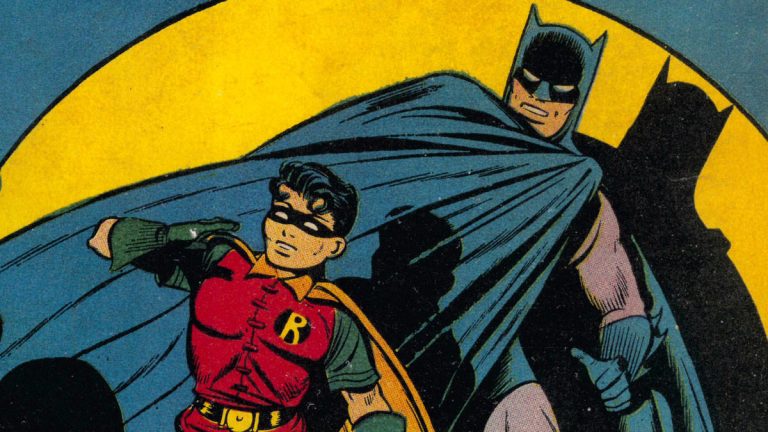
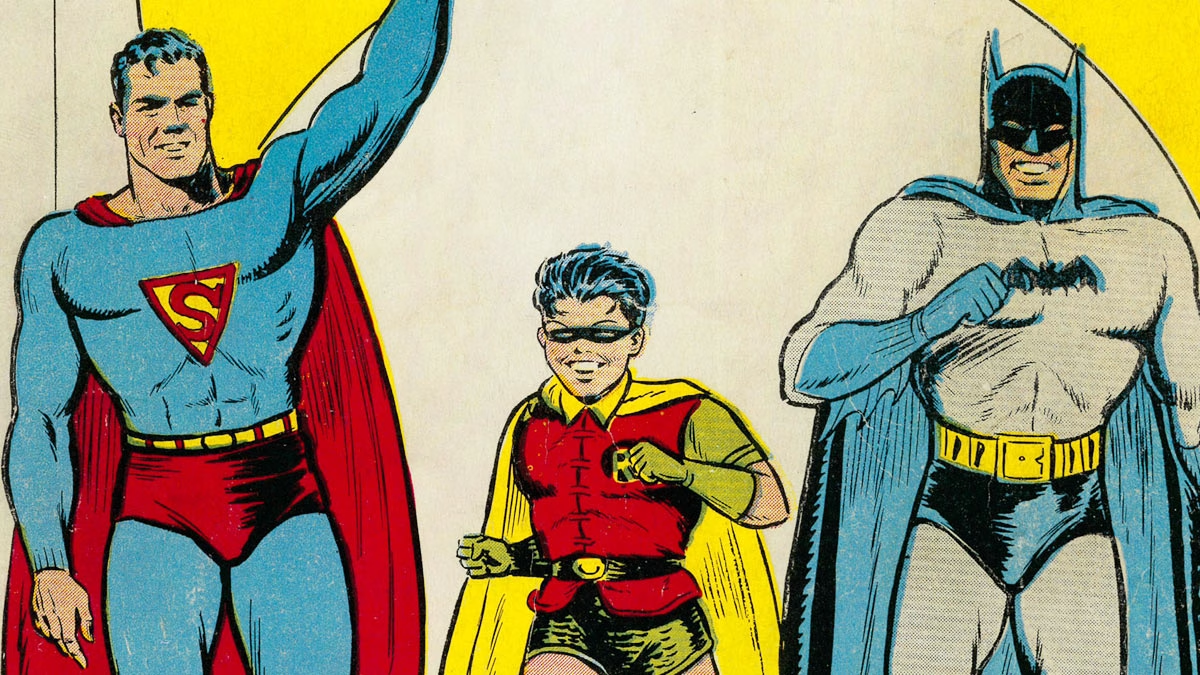
Superman, Robin, and Batman

The Origin Story of DC Comics and the Golden Age of Comics

Disclaimer: As an Amazon Associate, we earn from qualifying purchases (Affiliate Disclosure). Thanks!

The History of DC Comics started when Major Malcolm Wheeler-Nicholson, already well-established in the printing industry, set up National Allied Publications and launched New Fun: The Big Comic Magazine in 1935. This was an oversized tabloid edited by Lloyd Jacquet. It worked well enough to justify the launch of another title, New Comics. Soon, the format changed (from tabloid to a more popular half-tabloid trim size) and the title too, as New Fun became More Fun Comics.

To meet the needs of this new successful venture, Wheeler-Nicholson started working with the printer and distributor Independent News, the company of Harry Donenfeld, who was also interested in investing in this new emerging market.

Ambitious, Malcolm Wheeler-Nicholson recruited editor Vince Sullivan to develop a new title, one that would be focused on only a popular theme: Detective Comics. In 1937, it was a departure from what was done before, as it was not just a collection of single-page comic strip-type stories, but a longer format. Before, four pages were the maximum for one tale. Now, it could go up to 13 pages, like with the “Slam Bradley” series by Jerry Siegel and Jo Shuster about a private detective.

Producing such a magazine demanded some money and new partners, including Donenefeld’s accountant and business manager, Jack Liebowitz, who joined the newly formed Detective Comics Inc. company. However, when Wheeler-Nicholson met some financial difficulties and declared bankruptcy, Harry Donenfeld bought Detective Comics.

The Golden Age of Comics: DC in Action

Developing a new title, Vince Sullivan commissioned Siegel and Shuster’s Superman story to fill the pages of Action Comics #1. This contract between the two creators and DC Comics will lead to a lot of legal disputes, but at the time, nothing could have suggested that the Man of Steel was going to become a cultural phenomenon, and it cost DC 130$ to buy the 13-page story.

Action Comics #1 sold out quickly and was reprinted again and again. It was the beginning of what would eventually be called the Golden Age of Comics.

Soon after, Superman got a promotion as, in January 1939, he became the star of his own newspaper daily comic strip (at the time, it was a prestigious honor). A few months later, everything Superman was reprinted in what was the first solo title for a comic book character, Superman #1.

An ad for Superman, only in Action Comics!

Inspired by this success, Sullivan went looking for his next hero and commissioned frequent collaborator Bob Kane to create it. He came back with a sketch of The Bat-Man. With Sullivan’s recommendation, writer Bill Finger was brought in to serve as a ghostwriter to assist Kane. Inspired by The Shadow and other pulp heroes, Batman made his debut in Detective Comics #27.

Harry Donenfeld decided to grow his comic book business with limited risks by distributing a new line of comics from Max Gaines. One of the titles he brought was Flash Comics #1, a story by Gardner Fox and Harry Lampert starring Jay Garrick, the fastest man alive, but also Hawkman, by Fox and Dennis Neville.

Fox had already created Sandman with artist Allen Bert Christman for National Comics, and soon introduced Starman with Jack Burnley and Doctor Fate with Howard Sherman. He became one of the most prolific comic book writers of his time (he produced more than 4000 stories). But Fox was not the only one working to add more heroes to the comic book world. Bill Finger collaborated with Martin Nodell on Green Lantern, starring Alan Scott. Writer Ken Fitch and artist Bernard Baily introduced Hourman. And more heroes started to appear elsewhere, like C.C. Beck and Bill Parker’s Captain Marvel for Whiz Comics.

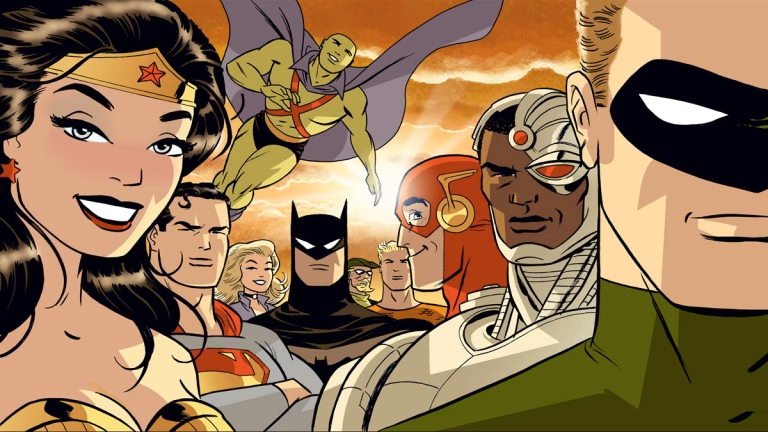
Business was growing. Superman became the star of a radio show and animated movies. DC’s logo started to appear on the cover of Action Comics (with issue #23, the one introducing Lex Luthor). Young Robin joined Batman’s crusade (in Detective Comics #38) while Catwoman and the Joker helped the Dark Knight to launch his own quarterly solo title, with Batman #1 in 1940. The following year, the first superhero team, the Justice Society of America (JSA), was launched. More heroes continued to be added to the DC Comics roster, including Aquaman and Green Arrow.

And then, one day, an article praising the importance of comics, a rare point of view at the time, led its writer, psychologist William Moulton Marston, to be invited to write for DC. Mixing his interests in mythology and women’s rights, he created in 1941 Wonder Woman with veteran artist Harry G. Peter. She first appeared in All-Star #8 before headlining Sensation Comics and her own quarterly solo title.

The War Began, The Heroes Flew Away

Everything was going well until the war started. By 1943, due to rationing and a lack of manpower, the page count per issue decreased from 64 to 48, and fewer titles appeared on newsstands. All was not grim as Batman got his own newspaper strip and a 15-chapter theatrical serial starring Lewis Wilson. New comics were still launched, such as Comic Cavalcade, All-Funny, Funny Stuff, Buzzy, All-American Comics, and more.

In the office, Max Gaines tried to gain independence, and instead was bought out by Donenfeld and Leibowitz. He went on creating EC Comics (he died soon after, in 1947, in a car accident). But there were bigger changes in the wind with all those “funny” titles, Disney Comics (published by Dell Comics), and other funny animals taking more and more space on the newsstands, pushing out superheroes.

All-Star Comics #16 cover by Frank Harry, spring 1943

With the end of the war, the trend didn’t slow down. DC even started to acquire licences to publish comic books based on popular radio shows like A Date with Judy and Mr. District Attorney. The title that started it all, More Fun Comics, was canceled, and Western Comics was launched.

Superman was still popular, though. He was even on TV in The Adventures of Superman starring George Reeves (from 1952–1958).

War comics, romance comics, science-fiction comics, western comics, everything but superheroes were gaining ground. After the Justice Society of America disappeared in All-Star Comics #57, the Golden Age of Comics was coming to an end. The last nail in the coffin was the book Seduction of the Innocent by Dr. Frederic Wertham, published in 1954, which led to the creation of the Comics Code Authority.

Superman flew into the Silver Age of Comics


This article was written with the help of 75 Years Of DC Comics: The Art Of Modern Mythmaking by Paul Levitz, published by Taschen.
More Files from the Casebook

  • The Batman Case Files: Introduction to Grant Morrison’s Masterpiece Run (2006-2013)

    Disclaimer: As an Amazon Associate, we earn from qualifying purchases (Affiliate Disclosure). Thanks!

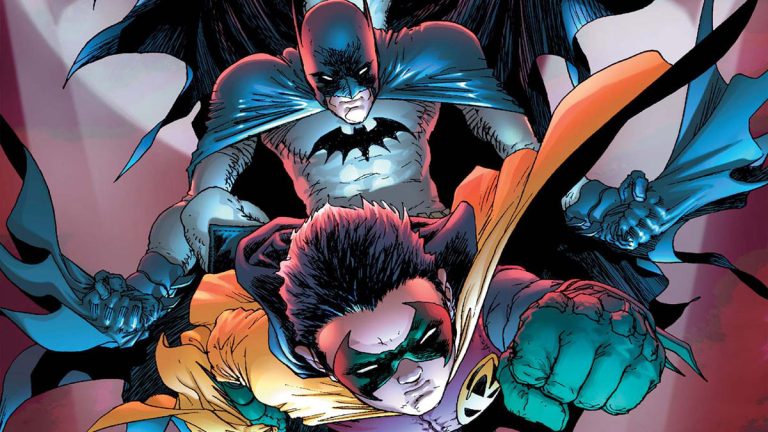
    Grant Morrison’s seven-year run on Batman is widely considered one of the most ambitious long-form epics in the history of modern comic books. Running across multiple titles from 2006 to 2013, the story functions as a massive three-act saga that breaks down Bruce Wayne before rebuilding him on a global scale.

    As it is a big read, this may not be the most inviting entry point for new readers. But it’s one influential run that continues to impress and, at times, leave a little confusion. It’s a dense and coherent narrative driven by big ideas, fueled by deep cuts into obscure DC lore.

    This article presents Grant Morrison’s run, outlining the key ideas, plot points, and characters. It serves as a roadmap providing context for my detailed reading order and retrospective review. So, let’s start exploring this rich case file!

    Of course, Morrison was not alone. During his run, he worked with artists Andy Kubert, J.H. Williams III, John Van Fleet, Tony Daniel, Ryan Benjamin, Lee Garbett, Frank Quitely, Philip Tan, Cameron Stewart, A,dy Clarke, Frazer Irving, Scott Kolins, Chris Sprouse, Ryan Sook, Yanick Paquette, George Jeanty, David Finch, Scott Clark, and Chris Burnham.

    Read More “The Batman Case Files: Introduction to Grant Morrison’s Masterpiece Run (2006-2013)”
  • DC Comics History: The Silver Age Rebirth of Superheroes

    Disclaimer: As an Amazon Associate, we earn from qualifying purchases (Affiliate Disclosure). Thanks!

    It was on a controversial note that the Golden Age ended. The history of American comics was changed forever by the adoption of the Comics Code. It will take decades to break free of it and, even then, its influence would never completely fade away.

    In March 1955, the Comics Code’s seal began appearing on DC Comics covers, like Action Comics #202, Superman #96, Batman #90, Detective Comics #217, Wonder Woman #73, and more… but not on too many costume superhero books, as those had already started to fade away.

    Read More “DC Comics History: The Silver Age Rebirth of Superheroes”
  • The Man of Tomorrow, Reborn: A Deep Dive into John Byrne’s Superman (1986-1988)

    Disclaimer: As an Amazon Associate, we earn from qualifying purchases (Affiliate Disclosure). Thanks!

    In the mid-1980s, Superman was in trouble. Decades of ‘Silver Age’ excess, such as super-dogs, pocket dimensions, and limitless powers, had made the Man of Steel feel both invincible and rather out of touch with the times. Following the universe-shaking ‘Crisis on Infinite Earths’, DC Comics did the unthinkable and recruited Marvel superstar John Byrne to rewrite Superman’s mythology.

    The result was a fundamental shift in perception that still influences how we view Clark Kent today. Whether you are an avid collector or a new reader exploring these issues in digital archives, Byrne’s work remains the definitive ‘modern’ starting point.

    Read More “The Man of Tomorrow, Reborn: A Deep Dive into John Byrne’s Superman (1986-1988)”
  • My Complete DC Roadmap: Key Runs, Events, and Milestones

    Disclaimer: As an Amazon Associate, we earn from qualifying purchases (Affiliate Disclosure). Thanks!

    Navigating nearly nine decades of DC Comics can feel less like diving into a universe and more like trying to map an infinite multiverse without a compass. Since Action Comics #1 debuted in 1938, so many creators have contributed to stacked timelines on top of resets, birthed golden-age legends, spun off dark-fantasy imprints, and launched cosmic-level crises. For seasoned fans seeking forgotten gems or new readers overwhelmed by where to begin, the sheer volume of material often makes knowing what to read the hardest part of the journey.

    That’s exactly the problem I faced recently (at the time of writing) while exploring possibilities for my next reading project for DC Casebook. As a result, I started looking into essential creator runs, historical milestones, monumental events, and obscure gems that shaped DC Comics history, from the sci-fi boom of the Silver Age to the mature dread of Vertigo and the modern ever-expanding universe. It soon spun out of control. What I came up with is what I call my DC Roadmap. It’s not exhaustive. It’s not definitive either. It’s full of runs, a lot I have not read, too. I just dig into the DC Comics catalog to look for books with a good reputation. I also tried to cover many of the big characters, because I have the ambition to read about some I barely know about.

    Simply put, it’s my way of getting a grasp on the evolution of the DC Universe, a tentative blueprint for the very best, or at least the most intriguing, DC has to offer. I’m open to more suggestions. The roadmap will never end.

    🚩Note on the organisation of the list: It’s not strictly chronological in terms of reading order, as I based it on start and end dates without giving it much further thought. When I explore a run, I’ll write a guide, but in the meantime, consider this a starting point, nothing more.

    Read More “My Complete DC Roadmap: Key Runs, Events, and Milestones”
  • The Black Casebook: Deconstructing the Silver Age Ghosts of Grant Morrison’s Batman

    Disclaimer: As an Amazon Associate, we earn from qualifying purchases (Affiliate Disclosure). Thanks!

    To a reader who is not all too familiar with Batman comics, Grant Morrison’s Batman run can, at times, feel like a fever dream. Why is there a “Bat-Mite”? Who are the “International Heroes”? The answer lies in The Black Casebook, a meta-fictional journal where Bruce Wayne recorded every encounter that defied logic, physics, or sanity.

    When I first read this run, my knowledge of Batman was limited to recent publications. I lacked a broader understanding of what the character went through. Even some recurring characters were not known to me. I caught up quickly, as the stories Morrison wrote don’t require you to be a Dark Knight scholar to be understood, but the more you know, the more you can appreciate what the author did.

    So, in this DC Casebook investigation, we strip away the modern shadows to reveal the 1950s and 60s “Golden & Silver Age” stories that Morrison transformed into psychological pieces to explore the mind of the Bat.

    Read More “The Black Casebook: Deconstructing the Silver Age Ghosts of Grant Morrison’s Batman”
  • DC Comics History: The Bronze Age, From Explosion to Implosion

    Disclaimer: As an Amazon Associate, we earn from qualifying purchases (Affiliate Disclosure). Thanks!

    For DC Comics, the Silver Age was an era of reinvention when it came to its line of superhero comics, but it was the same people who were still creating those comics. With Marvel Comics becoming a serious competitor, changes were once again needed, but this time they were just as much on the pages as behind the scenes.

    New editorial director Carmine Infantino brought change in a notable way. The funny animal comics disappeared, and “Weird” comics became à la mode (Weird Western, Weird Adventure Comics, Weird War, Weird Mystery). But Infantino’s important change was to give artists power and to bring new talents in. Marv Wolfman, Len Wein, Denis O’Neil, and Neil Adams soon became important names at DC.

    Read More “DC Comics History: The Bronze Age, From Explosion to Implosion”

Leave a Reply

Your email address will not be published. Required fields are marked *