The Black Casebook: Deconstructing the Silver Age Ghosts of Grant Morrison’s Batman

Disclaimer: As an Amazon Associate, we earn from qualifying purchases (Affiliate Disclosure). Thanks!

To a reader who is not all too familiar with Batman comics, Grant Morrison’s Batman run can, at times, feel like a fever dream. Why is there a “Bat-Mite”? Who are the “International Heroes”? The answer lies in The Black Casebook, a meta-fictional journal where Bruce Wayne recorded every encounter that defied logic, physics, or sanity.

When I first read this run, my knowledge of Batman was limited to recent publications. I lacked a broader understanding of what the character went through. Even some recurring characters were not known to me. I caught up quickly, as the stories Morrison wrote don’t require you to be a Dark Knight scholar to be understood, but the more you know, the more you can appreciate what the author did.

So, in this DC Casebook investigation, we strip away the modern shadows to reveal the 1950s and 60s “Golden & Silver Age” stories that Morrison transformed into psychological pieces to explore the mind of the Bat.


📂 What is the Black Casebook?

Historically, the Black Casebook was a 2009 trade paperback released by DC to collect the specific stories Morrison was referencing. The book is presented as Bruce Wayne’s private ledger of “unsolved cases,” what the author describes as Batman’s X-Files, events he originally dismissed as hallucinations, alien encounters, or chemical trips, but which return to haunt him during the Black Glove and Batman R.I.P. storylines. You can look for them in The Complete Grant Morrison Batman Reading Order (coming soon).

So I decided to treat the entire publishing history of Batman as events in one man’s extraordinarily vivid life. This for me was the story that hadn’t been told; the story of how his life might include the complete trajectory of Batman as a character from the 1930s to 2000s. The story of what that life might do to a man’s mind. And the story of an ultimate villain capable of scploiting that entire history as a means of destroying Batman.❞ — The Black Casebook introduction by Grant Morrison.

Why You Should Read the Black Casebook First?

You don’t need to read the 1950s comics to enjoy Morrison’s run, but they add a layer of understanding to what he referred to, making us feel like we are in the know. I don’t think those old stories are even easy to read. They are outdated, but they also have some charm. I would say that casual readers can skip them, but if you are looking for the complete immersive experience, go ahead.

Collecting the Black Casebook in 2026

The first printing of the Black Casebook came out in 2009. Since then, this original paperback edition may have been hard to find, but DC Comics is reprinting it in 2026 in a Deluxe Hardcover Edition.

  • Batman: Black Casebook (2009, TPB) – collects stories from Detective Comics #215, #235, #247, and #267; Batman #65, #86, #112, #113, #134, #156, #162; and World’s Finest Comics #89.
  • Batman: Black Casebook: Deluxe Edition (2026, Hardcover) – Collects stories from Detective Comics #148, #215, #235, #241, #247, and #267; Batman #62, #65, #77, #86, #112, #113, #134, #153, #156, #162, #180, and #452-454; and World’s Finest Comics #89 and #223, along with a story by Morrison and Burnham from Detective Comics #1027.
Detective Comics #235

📂The Case Files: From Whimsy to Weapon

Morrison’s genius was taking “silly” stories and giving them a dark, modern explanation (usually involving isolation experiments or psychological triggers). Truly, reading them today, they are almost like parodies, something a tad absurd done in a cheeky tone, a bit like a fever dream set in the world of the 1966 Batman TV Show.

Case File #1: “A Partner For Batman!” – Batman #65 (June, 1951)

Robin broke his leg, and Gordon arrives with a new mission for Batman: to train a European Batman. Robin becomes convinced he is being replaced (it was not the case).

“Batman – Indian Chief” – Batman #86 (September, 1954)

Far from Gotham City, Batman and Robin stumble upon Chief Man-of-the-Bats and Little Raven, who are dressed as local Batman and Robin to fight the villainous Black Elk. To protect their identities to be discover, the real Batman and Robin take the place of their Amerindian counterparts.

“The Batmen of All Nations” – Detective Comics #215 (January, 1955)

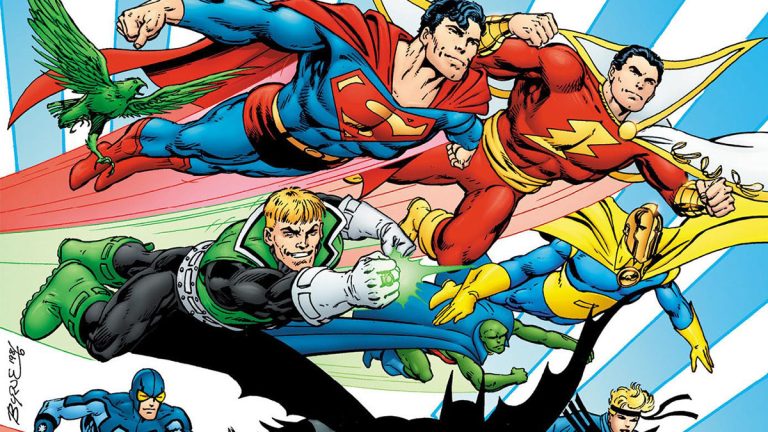
The Knight and The Squire, The Musketeer, The Legionary, The Gaucho, The Ranger, crime fighters from around the world, inspired by Batman, come to Gotham City to learn his methods. But one of them is kidnapped and replaced beforehand to infiltrate the group and lead Batman into a trap.

“The First Batman” – Detective Comics #235 (September, 1956)

Bruce Wayne finds a Bat costume his father wore at a ball where he was kidnapped by criminals to help a robber in need of medical attention. Thomas Wayne stopped the bad guys. This led Batman to reopen the Wayne Murder Case to find if the two cases are related.

“The Club of Heroes” – World’s Finest #89 (July, 1957)

Philanthropist John Mayhew opens the Club of Heroes and invites Superman, Batman, and the Batmen of All Nations to join. But who will become the club’s chairman? Maybe the new superhero Lightning Man.

“The Man Who Ended Batman’s Career” – Detective Comics #247 (September, 1957)

Professor Milo makes Batman afraid of bats. He has to change and become “Starman” instead to continue fighting the criminals of Gotham City.

“Am I Really Batman?” – Batman #112 (December, 1957)

Batman wakes up in a mental hospital, where he is told he is not Batman. He escapes and tries to confront the man pretending to be the real Batman.

“The Superman of Planet X” – Batman #113 (February, 1958)

Batman is taken to the planet Zur-En-Arrh. A local scientist who became a Batman imitator teleported him to ask for his help to fight against an alien invader. Like Superman on Earth, Batman on Zur-En-Arrh has super-powers.

“Batman Meets Bat-Mite” – Detective Comics #267 (May, 1959)

Batman and Robin have to deal with their own Mister Mxyzptlk: Bat-Mite. A fan of the dynamic duo, he wants to join them to fight crime, but only creates chaos.

“The Rainbow Creature” – Batman #134 (September, 1960)

In a South American Republic, Batman and Robin have to fight against a strange 4-colour creature. Each colour is associated with a different power. Getting rid of it will require a four-part strategy.

“Robin Dies at Dawn” – Batman #156 (June, 1963)

Taken on another planet, Batman fights creatures and sees Robin dying (at dawn!). When he woke up, he realised that this was a hallucination, but soon he started seeing the monsters of his dream everywhere.

“The Batman Creature” – Batman #162 (March, 1964)

Scientist Eric Barroc uses an evolutionary ray to make animals into quasi-humans who commit crimes. When Batman confronts him, he is turned into an animal. Robin and Batwoman team up to stop him.


📂 DC Casebook: The Morrison Files

More Files from the Casebook

  • The Ultimate John Byrne Superman Reading Order (1986-1988)

    Disclaimer: As an Amazon Associate, we earn from qualifying purchases (Affiliate Disclosure). Thanks!

    John Byrne’s run on Superman wasn’t just limited to one book. It was a “Triangle Era” precursor where stories flowed between Superman, Action Comics, and Adventures of Superman (written by Marv Wolfman, but essential for context).

    Here is the ultimate contextual reading order.

    Read More “The Ultimate John Byrne Superman Reading Order (1986-1988)”
  • The Batman Case Files: Introduction to Grant Morrison’s Masterpiece Run (2006-2013)

    Disclaimer: As an Amazon Associate, we earn from qualifying purchases (Affiliate Disclosure). Thanks!

    Grant Morrison’s seven-year run on Batman is widely considered one of the most ambitious long-form epics in the history of modern comic books. Running across multiple titles from 2006 to 2013, the story functions as a massive three-act saga that breaks down Bruce Wayne before rebuilding him on a global scale.

    As it is a big read, this may not be the most inviting entry point for new readers. But it’s one influential run that continues to impress and, at times, leave a little confusion. It’s a dense and coherent narrative driven by big ideas, fueled by deep cuts into obscure DC lore.

    This article presents Grant Morrison’s run, outlining the key ideas, plot points, and characters. It serves as a roadmap providing context for my detailed reading order and retrospective review. So, let’s start exploring this rich case file!

    Of course, Morrison was not alone. During his run, he worked with artists Andy Kubert, J.H. Williams III, John Van Fleet, Tony Daniel, Ryan Benjamin, Lee Garbett, Frank Quitely, Philip Tan, Cameron Stewart, A,dy Clarke, Frazer Irving, Scott Kolins, Chris Sprouse, Ryan Sook, Yanick Paquette, George Jeanty, David Finch, Scott Clark, and Chris Burnham.

    Read More “The Batman Case Files: Introduction to Grant Morrison’s Masterpiece Run (2006-2013)”
  • |

    Final Crisis Reading Order: The Day Evil Won (2008)

    Disclaimer: As an Amazon Associate, we earn from qualifying purchases (Affiliate Disclosure). Thanks!

    With Batman R.I.P., Grant Morrison not only wrote the psychological destruction of the Dark Knight, but also paved the way for a new threat menacing the whole DC Multiverse, one that went beyond physical conquest. Final Crisis is the story of the “God of Evil,” Darkseid, finally discovering the Anti-Life Equation and using it to enslave the consciousness of the human race.

    This isn’t a war fought only in the streets, it’s a war fought for the soul of reality. As the “New Gods” of Apokolips fall to Earth and inhabit human hosts, the sky turns red, time begins to collapse, and the heroes of the DC Universe are forced into a final stand against a darkness that has already won.

    Read More “Final Crisis Reading Order: The Day Evil Won (2008)”
  • Unsolved Cases: Whatever Happened to Misfit (Charlotte Gage-Radcliffe)?

    Disclaimer: As an Amazon Associate, we earn from qualifying purchases (Affiliate Disclosure). Thanks!

    After briefly crossing her path while reading Batman: Battle for the Cowl and Final Crisis, I was reminded of Misfit (aka Charlotte Gage-Radcliffe). I checked when she last appeared in the pages of a comic. It turns out she did make a cameo in Cheetah and Cheshire Rob the Justice League #4 by Greg Rucka and Nicola Scott (who created the Misfit costume originally), published last November (2025, for reference). That was the first appearance in over a decade! And I barely consider that relevant.

    In the late 2000s, Oracle’s inner circle was expanding, and no new recruit had more breakout potential than Charlotte Gage-Radcliffe. Dressed in a homemade, stitched-together Batgirl costume and shouting her trademark battle cry (“Dark Vengeance!“), Misfit brought a chaotic, endearing energy to Metropolis and Gotham.

    She had the powers, the tragic backstory, and Gail Simone writing her. So, what happened to Misfit?

    Read More “Unsolved Cases: Whatever Happened to Misfit (Charlotte Gage-Radcliffe)?”
  • Is John Byrne’s Superman Still Good? A 2026 Retrospective Review

    Disclaimer: As an Amazon Associate, we earn from qualifying purchases (Affiliate Disclosure). Thanks!

    In 1986, John Byrne undertook the challenging project of reimagining Superman as a relatable contemporary figure. This involved making some controversial decisions. He abandoned the optimism of the Silver Age in favour of a more psychologically grounded interpretation, shaped by the cultural logic of the 1980s. It was criticized by some for being Superman for adults. Four decades later, does it still resonate, or was it purely a product of its time?

    While later interpretations have emphasized Superman as a near-mythical ‘space god’, Byrne’s work is the most notable ‘human-first’ reimagining of the character. It established the modern Lex Luthor and a proactive, credible Lois Lane, but it also led to a Superman who violated his own moral code in a conclusion that remains controversial. Whether regarded as a necessary modernization or a fundamental misreading of the character, Byrne’s influence continues to shape virtually every screen adaptation of Superman.

    Although I have read DC Comics for decades, I was never particularly interested in Superman. To broaden my understanding of the character, I approached this landmark series from a contemporary perspective. So, in this review, we’re looking past the nostalgia.

    Read More “Is John Byrne’s Superman Still Good? A 2026 Retrospective Review”
  • Resurrection of Ra’s al Ghul Reading Order: The Complete Guide for The Battle for the Heir

    Disclaimer: As an Amazon Associate, we earn from qualifying purchases (Affiliate Disclosure). Thanks!

    When Grant Morrison started writing his celebrated seven-year run on Batman, his first major contribution to the lore was the introduction of Damian Wayne, son of Bruce Wayne and Talia Al Ghul. He didn’t take long for DC Comics to put the boy at the center of a crossover event leading to The Resurrection of Ra’s al Ghul!

    The Ghul family made a big comeback, as dangerous as ever, and young Damian is to play a key role in bringing his grandfather fully back from the dead. But he is not easily controlled and will not just bend the knee when he has another side of the family ready to fight for him. Well, maybe not that ready, but Batman’s sons will never let someone die if they can save them.

    As the whole story spans across Batman, Detective Comics, Nightwing, and Robin, this is not a storyline entirely written by Grant Morrison. Peter Milligan, Paul Dini, Fabian Nicieza, and Keith Champagne also wrote one or more chapters, with artists Tony S. Daniel, Ryan Benjamin, Freddie Williams II, Don Kramer, David López, David Baldeón, and Derec Donovan.

    Read More “Resurrection of Ra’s al Ghul Reading Order: The Complete Guide for The Battle for the Heir”

Leave a Reply

Your email address will not be published. Required fields are marked *