Armageddon 2001 Reading Order & Review: Who’s Monarch? (1991)
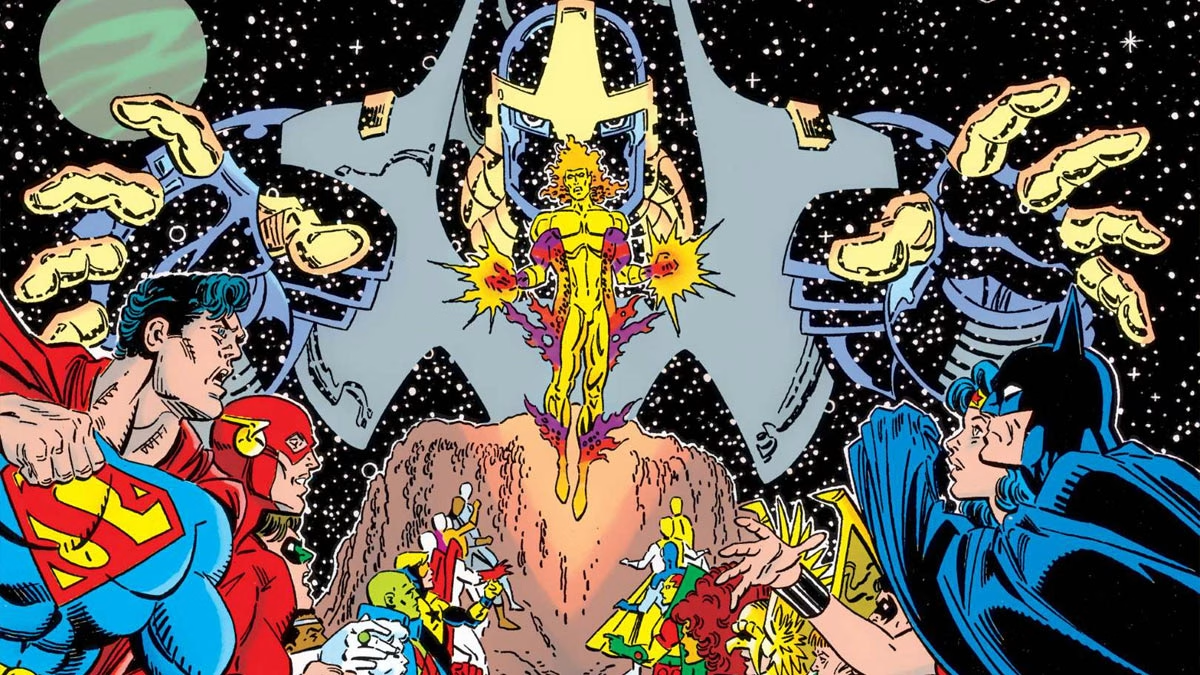
1991. While DC Comics was launching the Wonder Woman-related War of the Gods crossover event, another, less impressively scaled one was coming to a close: Armageddon 2001. It was one of those events published across many annuals. These tend to be forgotten, but this one was surrounded by enough controversy over its conclusion to leave its mark on comics history as a case study in how not to deal with your ending leaking in the press.
Created by writer Archie Goodwin and artist Dan Jurgens and brought to a close by editor and writer Dennis O’Neil, this event introduced several notable characters, making it hard for DC fans (and completists) to miss. Despite the controversial ending, Armageddon 2001 had a strong concept to begin with that would easily satisfy fans of Elseworlds stories. So let’s take a closer look (and in order, please)!
- What is Armageddon 2001 about?
- Collecting Armageddon 2001 in 2026?
- My review of the event
- The complete reading order
🔍 The Premise: The Hunt for the Future Tyrant
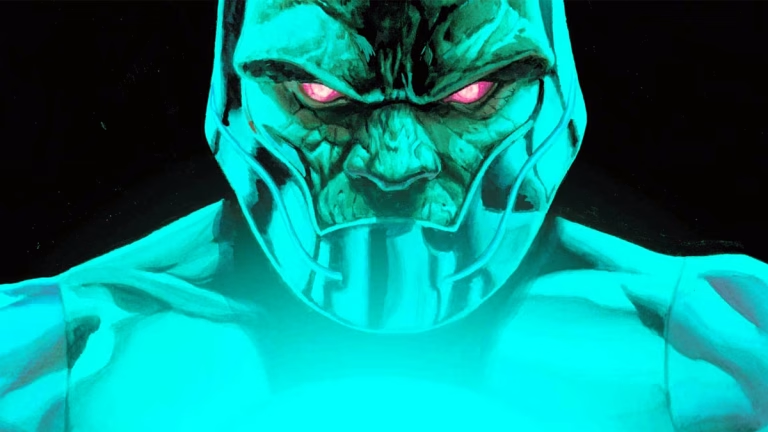
The story opens in a dark, dystopian year 2030. The entire planet is ruled by Monarch, a ruthless, armored tyrant who hunted down and slaughtered all of Earth’s superheroes to establish total dominance. A scientist named Matthew Ryder risks his life to test an experimental time-travel device, hoping to prevent Monarch’s rise.
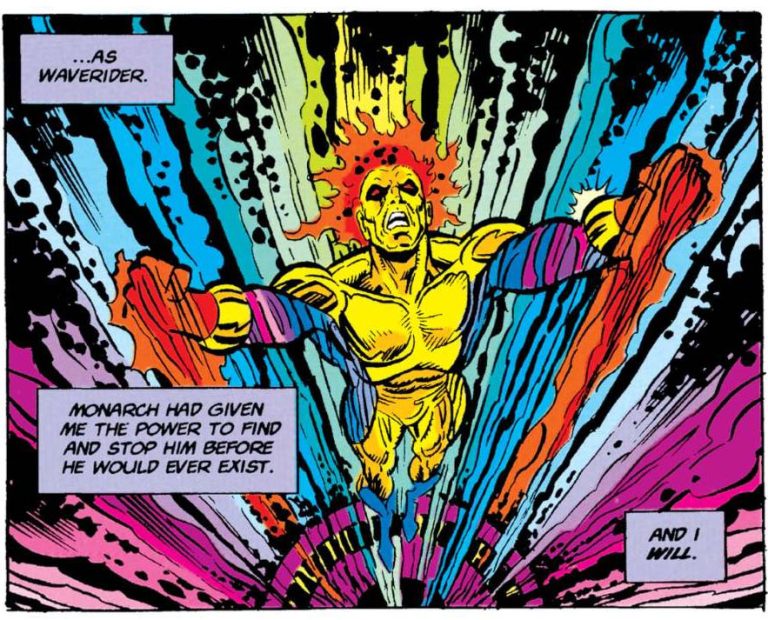
The experiment transforms Ryder into Waverider, a chronal entity that can move through the time-stream and see ten years into a person’s potential future with physical contact. Waverider knows only one thing: Monarch was originally one of Earth’s modern-day superheroes.
Traveling back to 1991, Waverider visits DC’s heroes one by one to look into their potential futures to discover who will become Monarch.
📚 Collecting Armageddon 2001 in 2026?
It’s not possible! That’s mostly it. DC Comics has not published a complete collected edition of this event yet. Even if you go to DC Universe Infinite, issues are not listed together in one place. You can find Armageddon 2001 #1-2 together there and on Kindle, but you’ll need to track down each tie-in individually.
In the complete reading order section of this article, I’ll link each issue to DC Universe Infinite, if they are available (they are not all available!).
✍️ My Review of Armageddon 2001 and its collection of What… Ifs!
Armageddon 2001 still has a pretty terrible reputation. As a result, I did not expect the first issue to be this strong. Writer Archie Goodwin and artist Dan Jurgens built the dystopian future in a very engaging way. There are some clichés and dated visual elements, but the way Matthew Ryder is introduced via his alienation from Monarch’s society and how it makes him a problem for others creates strong and relatable motivations. I thought this future where everything is fine for everybody who just follows the rules had a lot of potential. I almost hoped for Matthew to wait a bit longer before starting his time-traveling adventure.
But he didn’t. He went on, becoming Waverider through the process, allowing him to travel in 1991. There, he finds heroes, touches them to see if they will eventually become Monarch in the future. Each issue presents a tale about an alternate future, all of it enticing readers to look out for clues about Monarch’s identity. Of course, not all those comics are good, qualitatively speaking, but some are certainly better than others.
The Time Paradoxes
One of the main flaws of Armageddon 2001 is that most futures we see are just possibilities, but not on the same timeline. It’s made abundantly clear in the Hawk and Dove Annual. Then, Batman and Superman go through the process twice with different futures each time. And the final issue even acknowledges it, using it as a way to try to make sense of the whole idea. As a result, even if there’s some fun to be had with the concept, the Waverider’s quest feels useless. Consequently, the whole event feels like that too, to some degree. This is reinforced by the ending.
Whatever future Waverider explores, being only one possibility among many, will he ever find the truth about Monarch? Yes, in the final issue. But between the first and the last, it’s just What… Ifs? comics without consequences. As I said before, some are still good. Far from me is the idea of dismissing the whole event in one full sweep because there is a flaw in its conceit. But I would never recommend it to anyone who just read it for any other reason than learning about the origins of Waverider and Monarch, characters that found their ways in other stories, or the first appearance of Team Titans.
At least, if you stumble onto one issue, you can read it and enjoy it, even without the rest of the events. My favorites are: the humorous Justice League America Annual #5 and Justice League Europe Annual #2, Batman Annual #15 with its murder mystery twist, and the take on President Superman in Action Comics Annual #3.
The Nonsense Ending, a True Editorial Misstep?
The reason Armageddon 2001 stands as one of the most infamous editorial case studies in comic book history is that its ending was rewritten so quickly, nobody seems to have looked into making it make sense. So, what happened?
The story was constructed to point toward Captain Atom as Monarch. However, when the twist leaked before the finale’s publication, editorial decided that surprising the audience was more important than storytelling. The reveal of Monarch’s true identity was swapped at the last minute to Hawk (Hank Hall).
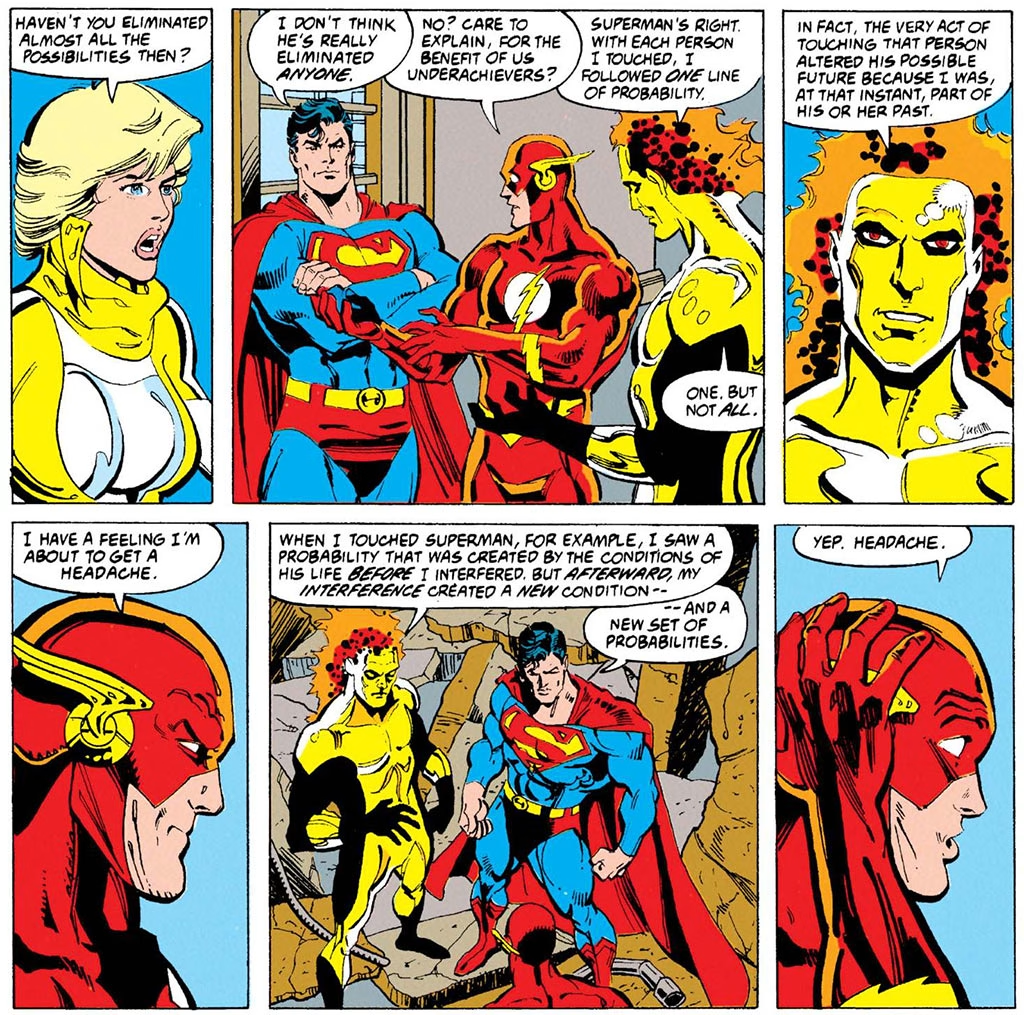
Maybe the hints at Captain Atom could be declared to have been red herrings, but in Hawk and Dove Annual #2, Waverider had already scanned many of Hawk’s futures, showing him explicitly fighting and dying against Monarch! It was the only issue in which the future really takes place in Monarch’s dystopian world. However, even if it’s hard to believe that a character like Hawk would credibly become Monarch, Dennis O’Neil, who wrote the issue, didn’t do such a bad job trying to sell it. The whole temporal logic behind Waverider’s vision of the future was clunky, but using Schrödinger’s observer effect to explain it helped make it sound at least credible in the moment. By looking into the hero’s future, Waverider influenced it.
Still, it all happens so quickly that it sounds almost absurd in the moment. But the more the story progresses, the more it starts to read like a parody. It was necessary to explain how someone like Hawl could defeat all of Earth’s Superheroes, as he clearly did not have the powers to do so. The explanation does not fit in a comic from 1991. It’s more Silver Age style, and not from the top of the line.
It was a mess, and it still is. Armageddon 2001 had a strong start, but it became more of a gimmick before crashing completely.
📜 Complete Armageddon 2001 Issue-by-Issue Reading Order
Follow this reading path to experience the full mystery as published in 1991.
- Armageddon 2001 #1 – It’s 2030. Monarch is in control, and rebel scientist Matthew Ryder looks for a way to change the world. A new time machine could make his dream a reality, but he needs access.
After that, each issue introduced a possible future for the Superheroes of 1991.
- Superman (Vol. 2) Annual #3: Superman didn’t dismantle Intergang, who accidentally nuked Metropolis. After that, the Man of Steel destroyed the Nuclear arsenal of the world and stole from rich countries to help the poor ones, but the US government wants him stopped and asks Batman’s help.
- Batman Annual #15 (collected in Batman: The Caped Crusader Vol. 4): The Joker is sane. Robin quits, and someone starts killing Batman’s enemies. Condemned for crimes he didn’t commit, Batman is in jail, waiting for the truth and the end.
- Justice League America Annual #5 (Collected in Justice League International Omnibus Vol. 3): Disguised as Captain Atom, Waverider joins the JL after Maxwell Lord has been shot and put in a coma. Everybody is here, waiting for news. Waverider looks into each one of their future.
- Action Comics Annual #3: Having changed his future once following Waverider’s first visit, Superman is on a new path that will lead him to become President of the United States of America.
- L.E.G.I.O.N. ’91 Annual #2: While Lobo’s future is the same as his present, Waverider met with Vril Dox, who will become another type of Tyrant.
- Hawkworld (Vol. 2) Annual #2: Katar Hol had given up the wings to change the system from the inside, but failed. Now, he starts flying again, and Attila makes a comeback.
- Hawk and Dove (Vol. 3) Annual #2: Waverider looks into Hawk’s future fighting Monarch, and a possible Dove’s future, before seeing how their child could be the key to winning.
- The Flash (Vol. 2) Annual #4: To put a dangerous criminal in jail, Wally West must testify and join the witness protection program to protect his family. Ten years later, his son’s life is in danger, it’s time to run again.
- The Adventures of Superman Annual #3: After Lois dies while pregnant, Superman leaves Earth and meets Maxima, who sees an opportunity to get what power and love she seeks.
- Detective Comics Annual #4: Batman’s war against Ra’s al Ghul reaches a new deadly level. Who will survive?
- The New Titans Annual #7: In the future, Nightwing led his Team Titans in a battle against dictator Lord Chaos.
- Justice League Europe Annual #2 (Collected in Justice League International Omnibus Vol. 3): Superman introduces Waverider to the JLE for him to get a peek at their future, which seems to be the past.
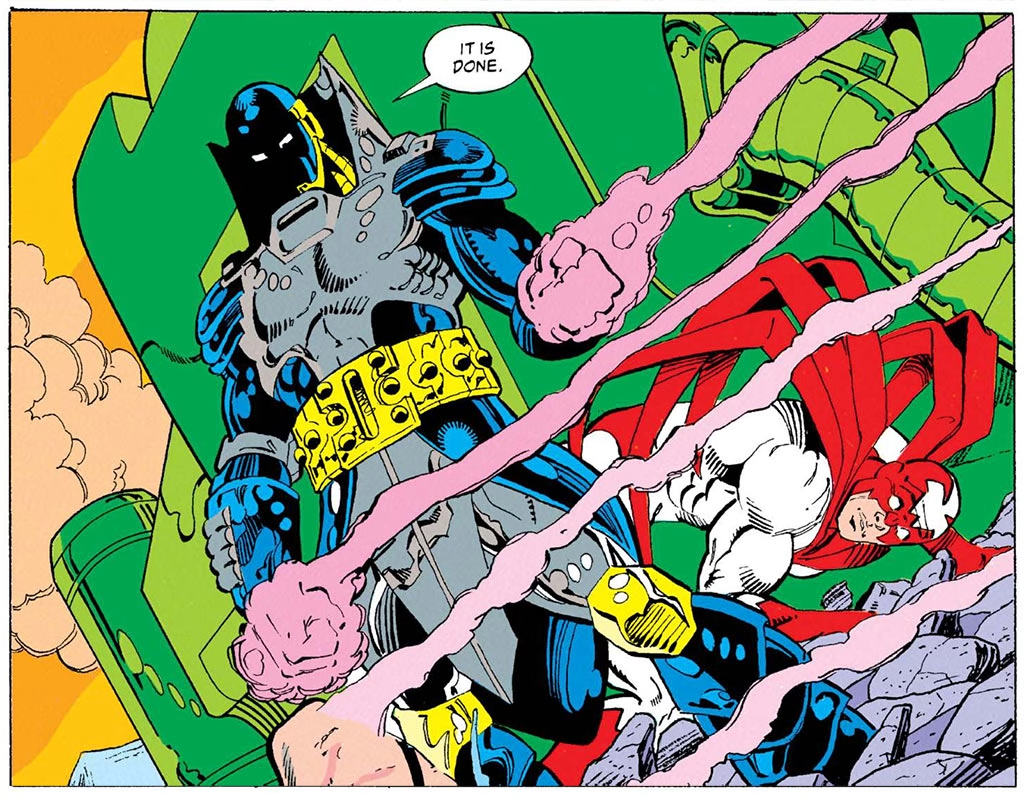
- Armageddon 2001 #2: Exploring Captain Atom’s possible future, Waverider realizes he was played by Monarch, who followed him to 1991.
After Armageddon…
- Action Comics #670: Monarch’s attack happens in the middle of this issue, which eventually deals with the consequences of the destruction that occurred during the fight.
- Superman (Vol. 2) #61: Dealing with the wreckage of S.T.A.R. Labs, Superman works with the Metal Men under Waverider’s eyes when a mysterious time-traveling woman takes Superman away to Vanishing Point.
- Armageddon – Alien Agenda: Following Armageddon 2001 #2, Captain Atom and Monarch are trapped in prehistoric times, facing dinosaurs and aliens. It’s only the start of their trip home through time.
- Armageddon – Inferno: Waverider has to face Abraxis, the ruler of another dimension, and recruit heroes to help him.
Published nine years later, JSA #14 retconned the ending of Armageddon 2001 by revealing that Mordru is responsible for manipulating Hawk into becoming Monarch.
👉 What’s Coming Next?
Everything didn’t end here. Dan Jurgens, who was the artist on the two main issues of this event, went on to write and draw Zero Hour: Crisis in Time, in which Waverider and Monarch made a comeback. It was his way to deal with continuity problems.
[Proceed to Next Case: Zero Hour]