Green Lantern Case File: Emerald Twilight (1994) – The Fall of Hal Jordan (Review + Reading Guide)
It all started at the end of the “Reign of Supermen” saga, in 1993. Mongul decimated Coast City (in Green Lantern #46!). Hal Jordan’s hometown and everyone in it were a thing of the past, and Earth’s Green Lantern wasn’t ready to let anything go.
This catastrophic event paved the way for what was one of the most controversial storylines in time: Emerald Twilight. A hero broke bad, lost his mind, and committed horrible acts of violence. This story, written by Ron Marz with art by Bill Willingham, Fred Haynes, and Darryl Banks, opened the way for a new Green Lantern, Kyle Rayner, while Hal Jordan became the cosmic threat Parallax. It’s now considered a classic, so let’s dig into it!
📚 Collecting Emerald Twilight in 2026
Despite Emerald Twilight’s notoriety, DC Comics doesn’t have multiple collected editions. Probably because it’s only three issues long (Green Lantern #48-50), hardly enough. That said, it’s systematically collected with the start of Kyle Rayner’s adventures.
- Green Lantern: Kyle Rayner Vol. 1 (2026 Edition) – Green Lantern (vol. 3) #48-57, New Titans #116-117 and R.E.B.E.L.S. #1
- Green Lantern: Kyle Rayner Compendium Vol. 1 – Green Lantern (vol. 3) #0, #48-65; R.E.B.E.L.S. ’94 #1; New Titans #116-117, #124-125; Guy Gardner: Warrior #27-28; Darkstars #34; and Damage #16.
- Green Lantern: Emerald Twilight, New Dawn (2003 Trade Paperback) – Green Lantern (vol. 3) #48-55.
- Available digitally on DC Universe Infinite.
✍️ My Review of Emerald Twilight
The idea behind Emerald Twilight was to boost sales numbers and save the Green Lantern book from cancellation by following the same road as The Death of Superman and Knightfall. Killing Hal Jordan, who had been deemed a slightly outdated character for the 1990s. A new Lantern would be introduced, and the idea of creating him was what pushed Ron Marz to take on the assignment. While he was not the one who had planned what was to become of Hal Jordan and the Corps, he did receive death threats as a consequence. Fans were certainly upset. But Kyle Rayner quickly gained popularity (even if his girlfriend ended up stuffed in a refrigerator, but it’s a story for another time).
So, it was not an easy task to begin with, to say the least. Superheroes tend to stick to their status quo pretty closely. Making Hal Jordan the bad guy needed some build-up. There was none.
The way DC Comics collects the story, most people probably just start with Green Lantern #48. It is the beginning of the storyline. However, everything began for Hal two issues earlier, when he came back to find Coast City annihilated. Mongul and the Cyborg Superman were stopped before they could continue their massacre, and Hal Jordan accepted the tragedy. In Green Lantern #47, a team-up with Green Arrow, the two characters reflect on their need to move forward. There’s hope for a better future. So, when you start reading issue #48, it’s slightly confusing to see Hal emotionally destroyed by the catastrophe, no longer focused on looking forward. Clearly, someone at DC Comics changed its mind, and readers had to just accept it.
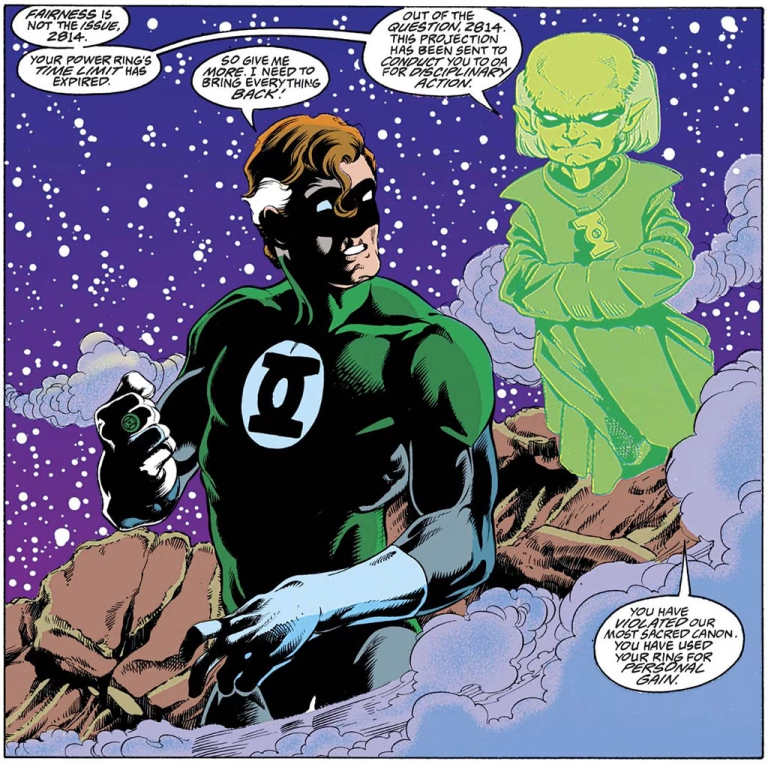
Overall, the three-issue storyline delivers a steady and logical progression to Hal Jordan’s descent into madness, but the starting point is certainly flawed. On its own, Emerald Twilight is a fine read. It digs into Hal’s complicated relationship with his father and what Coast City meant to him, making his rage against the Guardians, who decided Hal’s plan to bring back the city was grounds for immediate dismissal from the corps, understandable. What came after is a surprising, by superhero narrative standards, turn of events. More deaths and destruction at the hands of the best Green Lantern of all. It’s shocking, especially when Hal fights Kilowog. It’s the point of no return.
Also, having the Guardians bring back Sinestro felt unnecessary. The idea was to show a sense of desperation, but the reunion didn’t have the impact needed to make it truly significant. At least, it showed how determined Hal Jordan was, but you only needed him facing Kilowog to make it clear that there was no coming back.
It all ends with a beginning for Kyle Rayner. That was the goal. Changing the main Green Lantern, putting him in a surprising situation that would help the book to gain a new momentum. But it left Hal Jordan in a grey area. The idea was to bring him back quickly during the upcoming Zero Hour: Crisis in Time, but when Emerald Twilight concluded, it felt like something was missing.
Emerald Twilight is the kind of story that became a “classic” by making something you usually don’t see in comic books (a long-time superhero becoming a villain) work well enough. At the time it was published, not everybody would have said it worked, though. In fact, the period of Hal as Parallax is still a controversial one among fans.
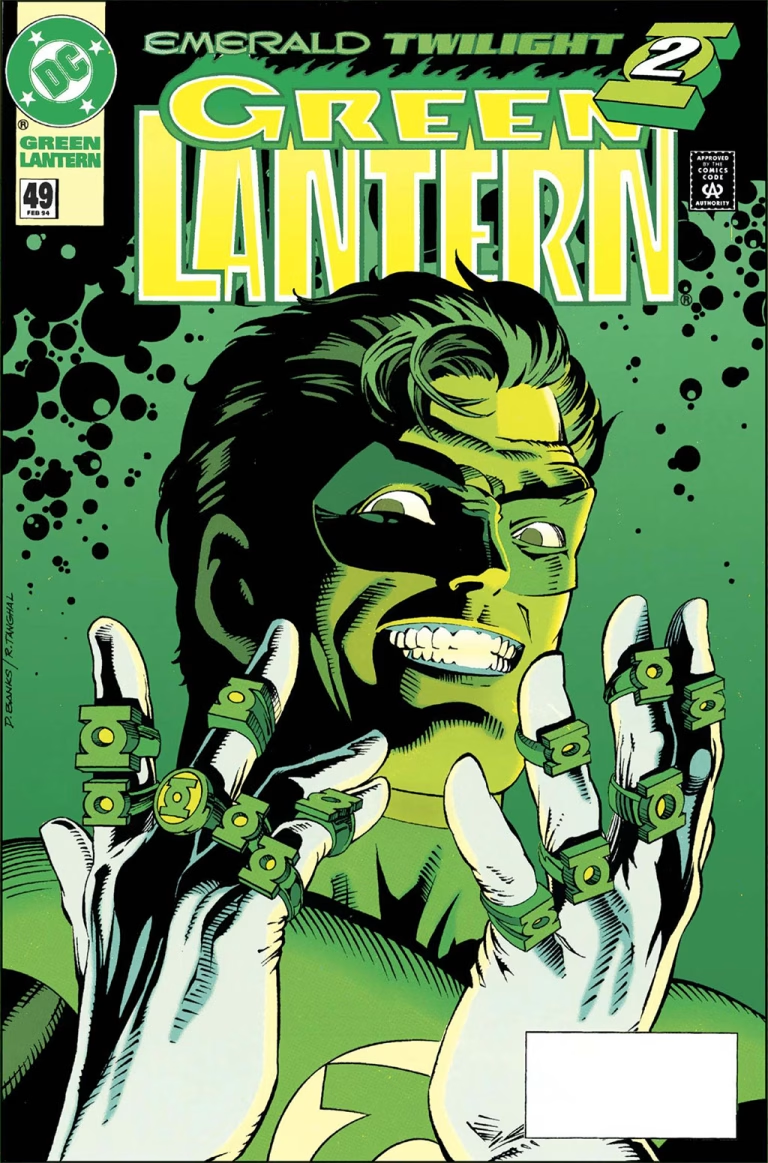
Finally, I didn’t write anything about the art. I’m not a fan of having a different artist for each issue. Even if their styles are close, it always slightly gets me out of the story. That said, I noted that Bill Willingham’s panel composition was well thought out and Darryl Banks delivered a final issue as dynamic as it is violent. But the most memorable image in the entire storyline is undoubtedly Banks’ cover for Green Lantern #49. It is the most striking image associated with Emerald Twilight. It is a true classic of a cover.
👉 The Emerald Twilight Reading Guide
Emerald Twilight may only be three issues, but here is a guide to help you navigate the world of the Green Lanterns around the event.
Prelude
- Green Lantern (vol. 3) #46: Reign of Superman Tie-In. Back on Earth from an offworld mission, Green Lantern Hal Jordan finds that Coast City has been destroyed! Cyber Superman and Mongul replaced it with a huge alien engine. Now, GL faces off with Mongul!
- Green Lantern (vol. 3) #47: Green Lantern & Green Arrow reunite to tie up some loose ends. This issue isn’t related to Emerald Twilight, so if you haven’t read the previous storyline, it’s best to skip it, as it won’t make sense and the tone doesn’t match up with what comes next.
Emerald Twilight
- Green Lantern (vol. 3) #48: Hal Jordan wills Coast City and his parents back for a short time.
- Green Lantern (vol. 3) #49: Hal Jordan is on the deadly road to OA, gathering rage and rings.
- Green Lantern (vol. 3) #50: The fall of the Corps and the Guardians… A new threat and a new Lantern emerge.
On the cover of Green Lantern Corps Quarterly #8, you can read “Emerald Twilight signals the end of Green Lantern Corps Quarterly”, and it’s not false advertising. If you have that issue at hand, know that in this anthology issue featuring GL Corps stories set in distant and not-so-distant past, the wrapping narrative uses the events of Emerald Twilight. So, spoiler alert!
Emerald Fallout
- Guy Gardner: Warrior #18-21: Guy Gardner’s ring stops working, and some maniac wants to kill him. Soon, he has to go to OA with some of his Justice League friends to find out what’s going on. The story explores the immediate consequences of Hal Jordan’s action on OA.
- Green Lantern (vol. 3) #51: Kyle Rayner is the last official Green Lantern in the universe. With nobody to teach him the ropes, he tries to understand his powers while facing villains.
- Green Lantern (vol. 3) #52-53: Mongul is back for vengeance. He wants to kill Green Lantern and doesn’t care that it’s not Hal Jordan wearing the ring.
- Green Lantern (vol. 3) #54-55: While Kyle is taking care of something strange (prelude to Zero Hour) in Los Angeles, the government sends Major Force to get information on the identity of the New Green Lantern. That’s the famous issue (#54) that inspired the naming of the “women in refrigerators” trope.
Hal Jordan’s next big move is coming in Zero Hour: Crisis in Time.